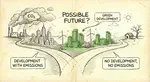
The global challenge of climate change is increasingly a place-based development challenge: investments that raise living standards also shape long-run emissions through energy systems, infrastructure, and urban form. This paper uses climate and non-climate development finance as a global laboratory to test whether development gains can be decoupled from CO2 emissions. I compile a global ADM2-level panel (2000–2022) linking geocoded aid project portfolios to local CO₂ emissions (EDGAR) and night-time lights (VIIRS). Climate-oriented portfolios are associated with small average declines in emissions—stronger where cumulative climate finance is large—while non-climate development finance systematically increases local emissions in the medium run. Night-time lights suggest expanding economic activity in mid-brightness regions, with muted effects in already bright places even as emissions rise. The results imply that meeting climate goals will require not only scaling climate finance but also greening mainstream development spending.