Research projects
My research evaluates how climate and development finance are allocated and what they do on the ground, combining geocoded project-level data, NLP-based reclassification of donor narratives, and modern causal-inference designs (DiD, event studies, double machine learning).
Each card below summarises an ongoing or completed project, with links to preprints, replication code, and companion sites where available.
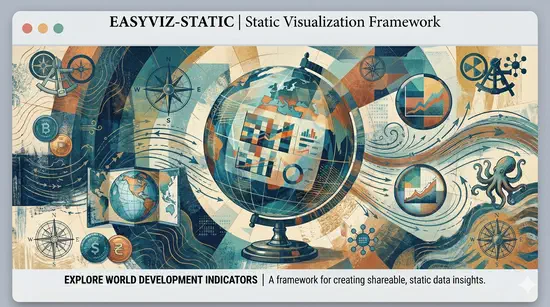
EasyViz — a static WDI explorer
I developed a static web app to explore World Bank WDI indicators directly from the browser. Loads in under a second, no backend, no cold start. Search 100+ curated indicators (or the full ~20k taxonomy), chart line/area/bar with country presets (OECD, EU27, SSA, BRICS, G7, LDC, LMIC, G20), compare indicators (scatter, bubble, OLS with R², Gapminder-style animation), upload your own CSV/XLSX, and share every view through a URL.
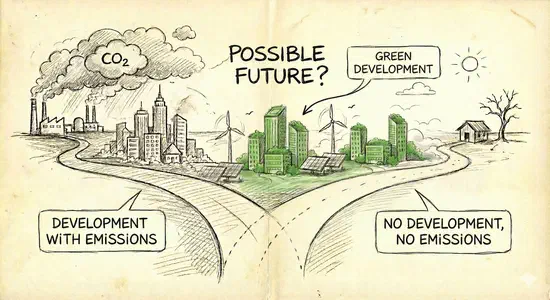
Development Goals, Emissions Costs? Climate and Development Finance vis-à-vis Local CO₂ Emissions
The global challenge of climate change is increasingly a place-based development challenge: investments that raise living standards also shape long-run emissions through energy systems, infrastructure, and urban form. This paper uses climate and non-climate development finance as a global laboratory to test whether development gains can be decoupled from CO2 emissions. I compile a global ADM2-level panel (2000–2022) linking geocoded aid project portfolios to local CO₂ emissions (EDGAR) and night-time lights (VIIRS). Climate-oriented portfolios are associated with small average declines in emissions—stronger where cumulative climate finance is large—while non-climate development finance systematically increases local emissions in the medium run. Night-time lights suggest expanding economic activity in mid-brightness regions, with muted effects in already bright places even as emissions rise. The results imply that meeting climate goals will require not only scaling climate finance but also greening mainstream development spending.
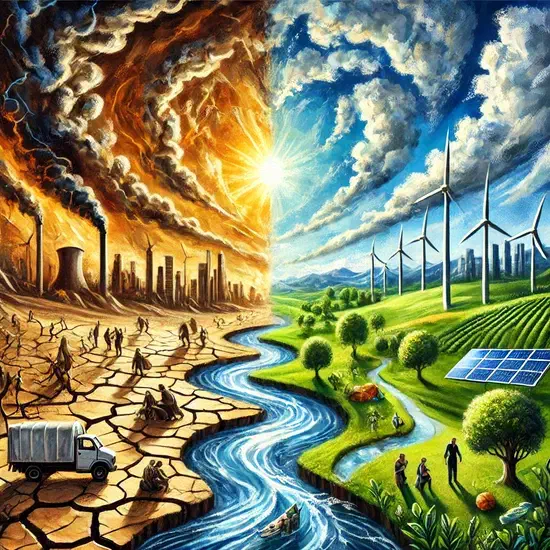
No plan, No Aid? The effects of National Adaptation Plan implementation on received Adaptation Aid
“No Plan, No Aid?” examines whether implementing a National Adaptation Plan (NAP) increases a country’s climate adaptation finance. Through a novel theoretical model and a robust Double Machine Learning (DML) approach, the authors find that NAP adoption does send mixed signals—reducing perceived vulnerability while boosting perceived capacity. Crucially, they find that while traditional econometric models show no impact or even a negative one, modern methods reveal a significant positive effect on adaptation aid.
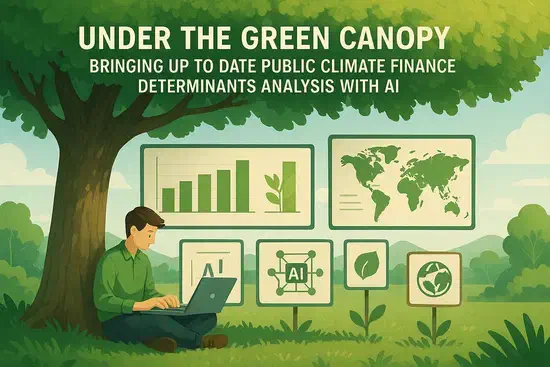
Under the Green Canopy: bringing up to date public climate finance determinants analysis with AI
Climate finance is critical for addressing the multifaceted challenges of climate change, encompassing mitigation, adaptation, and environmental sustainability. This study aims to renew the analysis of a critical part of climate finance determinants’ allocation across these dimensions and accurately estimate bilateral public climate finance flows using an advanced machine learning approach. ClimateFinanceBERT (Bidirectional Encoder Representations from Transformers) is employed to classify development finance projects, distinguishing those that contribute to climate mitigation, adaptation, and environmental objectives. By examining a comprehensive dataset of development finance projects (OECD CRS) and replicating a recent research on climate public aid determinants, this study identifies key factors influencing the allocation of climate finance. This work updates significant patterns in climate finance distribution. This research contributes to the growing field of climate finance by offering a robust analytical framework for assessing the determinants of climate finance and proposing a scalable solution for monitoring financial flows aimed at addressing climate change in its entirety. The insights gained have important implications for policymakers and stakeholders striving to understand and optimize the allocation of climate finance to support global sustainability and resilience goals.

Millions for billions: Accelerating African entrepreneurial emergence for accelerated, sustainable and job-rich growth
Publication from Jean-Michel Severino (https://ferdi.fr/biographies/jean-michel-severino) where I provided an appendix aiming to reveal the actual support provided by development finance institutions to the African private sector. The article below argues for the need to strongly accelerate public involvement in support of entrepreneurial emergence in poor and fragile countries. After mentioning the economic and employment issue, it explains how this priority has long disappeared from the international agenda as well as from domestic public policies, particularly in Africa. Efforts to promote the private sector have in practice focused on foreign direct investment and the largest companies. Middle- and emerging income countries, and a limited number of sectors and financial instruments, such as debt, have been valued. The article evokes the gradual change of perception on this subject from the beginning of the century and the emergence of new so- called impact actors focused particularly on SMEs in poor countries, accompanied by some public private sector financing institutions (DFIs), development agencies or foundations..